
A scooter has to work for the whole trip: the ride, the stairs, the place you leave it, and the journey home. Before comparing the HopCycle collection, write down the route you expect to take most often. The right choice starts with that ordinary day, not the longest range or highest speed in a headline.
This guide helps you turn your commute into a short list of requirements. You will work through distance, surfaces, carrying, tires, braking, and the details to check on your selected model. Keep those notes beside the product specifications so you can compare scooters on the things you will use.
Start with the trip you actually make
Map the complete round trip, including the distance between your home and the street, a transit stop and your destination, and any regular detours. A two-mile ride to work becomes four miles when you include the return. A grocery stop, a closed entrance, or a different route home adds distance too. Measure your likely route rather than the straight line between two addresses.
Next, consider what happens along the way. A short route with several stairs presents a different choice from a longer route with ground-floor storage. Smooth pavement, uneven joints, frequent stops, and hills each deserve a place in your notes. Visit an unfamiliar route before relying on it for a time-sensitive trip.
We suggest keeping the first version simple. Record the daily distance, the longest section without a convenient stop, the number of times you must lift the scooter, and where you can store it. Those four details give you a stronger starting point than a list of features with no connection to your routine.
Separate everyday needs from occasional wishes
You might want to take a longer weekend ride, but carry your scooter upstairs every weekday. Decide which task matters more. A choice that suits the rare trip can become awkward on the route you repeat. Give your regular commute priority, then check whether the occasional trip is realistic without stretching the scooter's published limits.
Check where a scooter fits into your route
Look beyond distance to the places where riding ends. Your office may have a particular storage area. A campus may restrict vehicles in certain buildings. A train or bus operator may have its own rules for bringing a folded scooter aboard. Check those policies directly before treating a scooter as a dependable connection between other forms of transport.
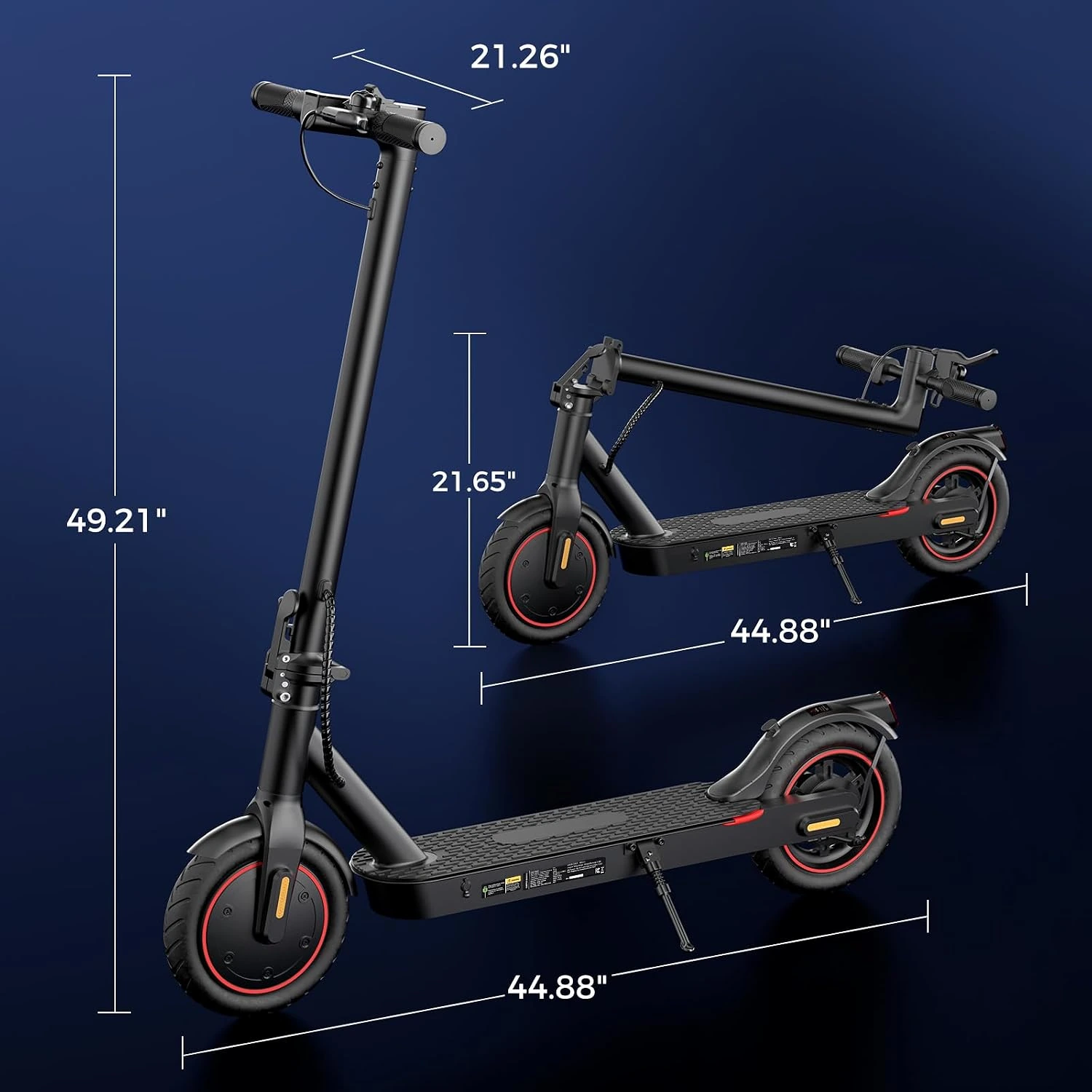
Make the same check at home. Measure a proposed storage space with doors open and closed. Think about walking past the scooter with a bag, reaching a closet, and moving it without disturbing other people. A folding stem reduces height, but the wheels, deck, and handlebars still occupy space.
For a mixed commute, write down the order of events: ride, fold, carry, board, store, unfold. That sequence exposes practical questions early. You may need to manage the scooter while holding a transit card, or carry it through a narrow entrance. Choose a model whose documented weight and folded dimensions fit those transitions, and check the applicable rules for every part of your journey.
Read range as a comparison point
An advertised maximum range is not a promise for every rider or route. Rider and cargo weight, terrain, speed, stops, temperature, tire pressure where applicable, and battery condition can affect the distance available from a charge. A number measured under favorable conditions may not describe a commute with hills and repeated acceleration.
Ask what conditions accompany the range claim. A stated test speed, rider weight, and surface help explain the result. If the conditions are not given, avoid filling the gap with your own assumption. Compare the claim cautiously and leave practical room for the return journey rather than planning a trip that consumes the entire advertised maximum.
There is no single percentage that converts every scooter's headline range into your personal range. A useful early goal is to learn your own routine on short trips with a convenient way home. Note the distance, mode, conditions, and battery reading. Use the pattern over several comparable rides to plan, while continuing to follow the model's operating limits.
Charging access also changes the decision. Confirm that you are permitted to charge at your destination before including it in your plan. An outlet in a hallway or shared room is not automatically available for personal equipment. If charging at work is uncertain, evaluate the round trip as one journey.
Give carrying weight its own decision
A scooter can feel manageable for a brief lift and cumbersome over several flights of stairs. Read the scooter's own weight separately from the maximum rider load. These figures answer different questions: one concerns the object you carry, while the other sets a limit for the load the scooter is designed to support.
Consider carrying distance as well as weight. Lifting a scooter into a trunk once is different from holding it through a station. The width of the handlebars and the folded shape affect how easily it passes through a doorway. The location of the intended carrying point matters too. Follow the model's instructions for folding, latching, and lifting instead of choosing a convenient-looking component.
Think about the rest of your belongings. A laptop bag, groceries, or other items can make a familiar staircase less convenient. Include those everyday objects when deciding whether the carrying task is realistic. Do not assume that a larger advertised range compensates for a carrying routine you will dislike twice a day.
When comparing HopCycle scooters, put weight and folded dimensions next to the distance figure. Seeing them together makes the tradeoff explicit. A model that suits your storage and lifting needs may be the more practical choice even when another has a more ambitious performance headline.
 Enlarge +
Understand the tire choice
Pneumatic tires contain air and require pressure checks. Solid tires do not use an air chamber. Honeycomb designs are also airless, with a pattern of openings in the tire. A product photograph may not make the distinction clear, so check the specification for the exact selected variant.
For pneumatic tires, include inflation in your maintenance routine. Find the pressure specified for the scooter and tire, and use the equipment described in the manual. Check whether access to the valve requires an extension. Do not borrow a pressure figure from a similar-looking model or assume that the maximum printed on a component is the recommended operating setting.
Airless tires remove the task of maintaining air pressure, but they still need inspection and eventual replacement. Look for damage and wear according to the manual. The absence of an inflatable tube does not make the entire scooter maintenance-free. Brakes, fasteners, folding parts, and electrical components still have their own care requirements.
For the buying decision, ask which maintenance routine you can keep up with. If you choose pneumatic tires, make space for the correct pump and gauge. If you choose solid or honeycomb tires, check the availability and fitting requirements of compatible replacements. Tire type is one part of the choice, alongside wheel size, suspension where fitted, and the condition of your route.
Look at brakes before top speed
Read the actual brake configuration, not just a phrase such as “dual braking.” The description should tell you which systems are fitted and how they are operated. An electronic brake, a drum brake, and a disc brake are different components. A shared product-family title may cover several configurations, so confirm the details of your chosen model.
The number of brake types alone does not establish a stopping distance. The CPSC advises riders to inspect the scooter before riding and learn how it stops. Its guidance also calls for a helmet and attention to obstacles, because small scooter wheels can react abruptly to uneven surfaces. Read the CPSC's scooter riding guidance before your first outing.
During selection, look for a clear manual, brake inspection instructions, and a way to obtain the correct replacement parts. After delivery, follow the specified checks and become familiar with the controls in an appropriate practice area before using a busy route. If a brake or control does not behave as the manual describes, resolve the problem before riding.
Put motor and speed claims in context
Motor power is useful only when you know what the number represents. A listing may state rated power, peak power, or simply a wattage without qualification. Do not treat those labels as interchangeable. Compare the same type of figure where it is provided, and read the model-specific details rather than combining the largest values from a family of scooters.
Top speed also has a narrower role than it first appears. Your route may include frequent crossings, people walking, limited visibility, or restrictions that make a headline maximum irrelevant. A speed mode is a control setting, not permission to travel at that speed everywhere. Check the rules that apply to your route and choose an appropriate setting for the conditions.
If you expect hills, identify where they occur and how much of the trip they occupy. Look for the manufacturer's guidance on use and loading for the exact scooter. Avoid predicting hill performance from watts alone. A photograph on an incline or an unqualified climbing claim does not explain how the scooter will behave with your load on your route.
Compare the exact model, color, and configuration
Online product families can be confusing. A color menu may change more than the finish. It can select a different battery, tire, brake arrangement, frame, or model. Before buying, record the model name and selected option, then check that the specifications and gallery describe that same combination.
Pay particular attention when a title contains several speeds, wheel sizes, or range figures separated by slashes. Those numbers often describe a group of options. They should not be combined into one imaginary scooter with every advertised advantage. Read the selected item's details from top to bottom, and ask the seller to clarify anything inconsistent before placing an order.
Photos can help you ask better questions. Look for the folding joint, wheel and brake areas, controls, lights, and any included accessories. A close-up is useful for understanding what is shown, but it does not replace a specification. Do not assume that a pictured bag, phone, helmet, or replacement part is included unless the contents list says so.
Keep a copy of the order details and the selected configuration. When the scooter arrives, compare the model label and contents with that record. This makes it easier to identify the right instructions and describe a problem accurately if you need order support.
 Enlarge +
Check documentation and certification carefully
Look for the manual that matches the exact model, including its assembly instructions, load limits, charging requirements, warnings, and maintenance schedule. A generic guide for another scooter may use familiar words while describing different hardware. Use the documentation supplied for your own unit, and clarify a mismatch before assembly or charging.
Certification claims need the same precision. UL Solutions explains that testing to a standard and product certification are different. For electric scooters, UL 2272 concerns the electrical system; it is not a claim that every rider, route, or maneuver is safe. Check the named certification body, model coverage, and applicable record instead of relying on a logo in a promotional image. See UL Solutions' explanation of product certification.
Also read the warranty and return terms before purchase. Check who handles the request, what information they require, and which conditions apply. A warranty period alone does not tell you what is covered. Retain the order confirmation and product identification so you have the details needed for a specific support question.
Plan charging as part of ownership
A suitable scooter also needs a suitable charging routine. Follow the instructions for your exact model and supplied charger, including connection steps and temperature limits. Make sure the place you plan to use is allowed by the property owner or building policy. Decide when you can remain present rather than treating charging as an unattended overnight task.
The CPSC recommends using the supplied charger, staying present during charging, never charging while asleep, and unplugging when charging is complete. It also advises using approved replacement battery packs and avoiding packs modified by unqualified people or made from repurposed cells. Its micromobility charging guidance provides a useful reference alongside your manual.
Keep the charger identifiable if your household has several rechargeable devices. A connector that fits is not enough to establish compatibility. If the original charger is lost or damaged, obtain the specified replacement through an appropriate support channel. Do not experiment with another device's charger to see whether it works.
Think about storage during time away as well. Read the battery and storage instructions before leaving a scooter unused for an extended period. Follow the stated schedule and conditions rather than a generic tip from a different product. Ownership is easier when the manual, order record, and charger remain together and easy to find.
Make room for setup and a first practice session
Allow time between delivery and your first necessary commute. Unpack carefully, check the contents, and read the assembly sequence before starting. Keep the packaging until you have confirmed that the scooter is correct and understand the applicable return arrangements. If something appears damaged or a required part is missing, contact the seller before proceeding.
Use the specified tools, fasteners, and tightening instructions. Do not substitute a procedure from a video of a similar scooter. Confirm that the folding mechanism is secured as directed and that cables are positioned correctly. Where the instructions require a particular adjustment or inspection, complete it before the first ride.
Set aside a separate session to learn the display, controls, starting procedure, and braking behavior. Choose an appropriate area and follow the model's safety instructions. A deadline is a poor reason to rush unfamiliar controls. Your first trip to an appointment should not also be your first attempt at folding, carrying, or operating the scooter.
Treat app features as supporting tools
If the selected scooter includes app connectivity, check the compatible phone requirements and the functions offered for that exact model. Battery readings, mode settings, or an electronic lock can be useful, but do not assume that every scooter in a range has every feature shown in an app screenshot.
Find out which basic controls are available on the scooter itself and which settings need the app. Complete pairing and configuration while stationary, following the manual. Keep your attention on the route when riding. If a connection fails, use the documented troubleshooting steps rather than changing unfamiliar settings at the roadside.
An electronic lock should not be your entire parking plan. Check the model's instructions and the rules at your destination, then choose an appropriate storage arrangement. Consider whether you will bring the scooter inside, where permitted, or use a designated area. The buying decision should include how the scooter fits into the hours between rides.
Build a shortlist you can explain
Use your route notes to compare two or three suitable options. Give each one a clear reason to remain on the list: manageable carrying weight, dimensions that fit your storage space, a tire routine you can maintain, or documented range that leaves room for your everyday journey. Remove choices that fail an essential requirement even if another feature looks appealing.
Your final checklist should be specific enough to use on the product page:
- The selected model and configuration match the specifications and photographs.
- The complete daily route fits your plan without depending on an unconfirmed charging stop.
- The scooter's weight and folded dimensions suit the places you must carry and store it.
- You understand the tire type, brake configuration, and basic maintenance requirements.
- You have read the correct manual and checked the charging, warranty, and support details.
- You have confirmed the rules for your route, destination, and any connecting transport.
Take that list back to the HopCycle range and compare the selected models one at a time. Choose the scooter that fits the journey you will repeat, with enough room in your routine for setup, care, and charging. If an essential specification is unclear, resolve that question before ordering.